
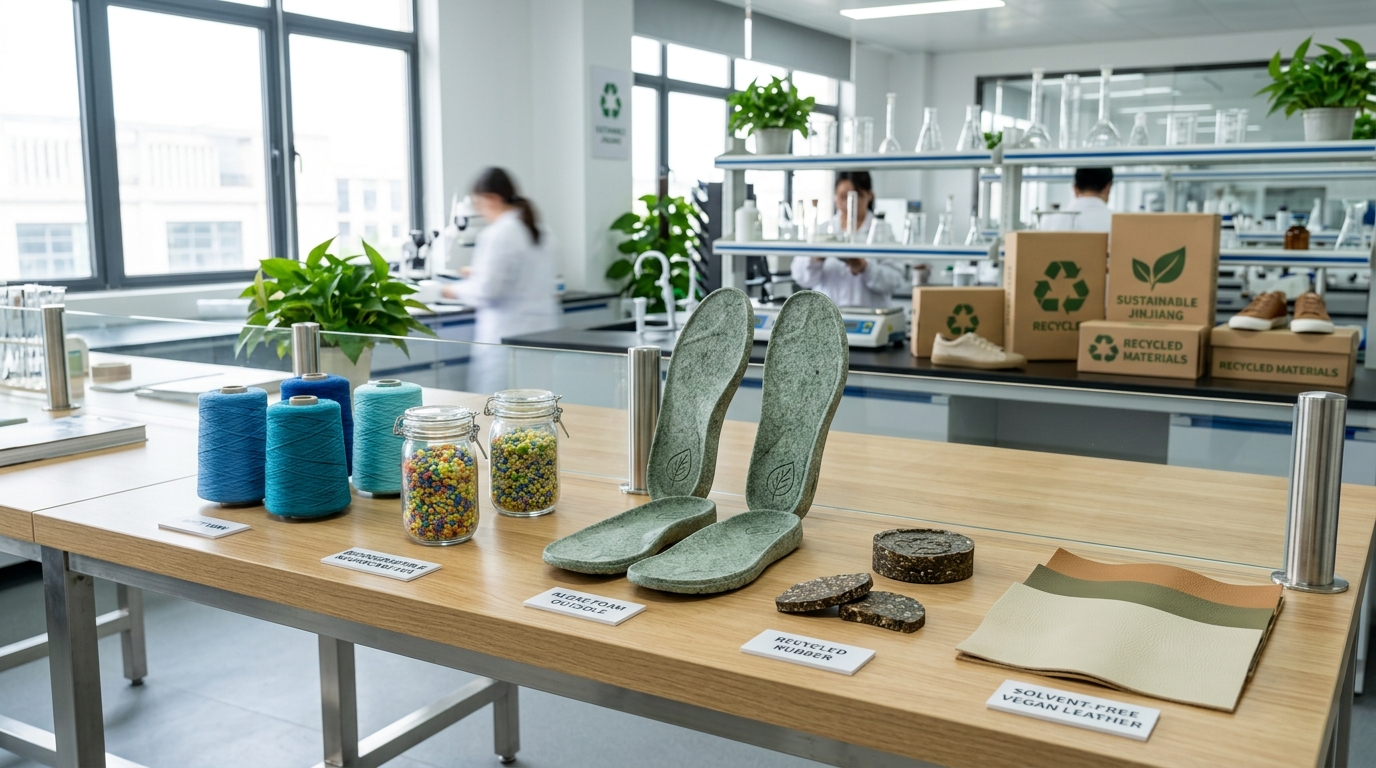
1. Executive Overview & Strategic Sourcing Dynamics: Supercritical Nitrogen Foaming vs. Traditional EVA: Energy Return, Compression Set & Midsole Engineering Science
The global landscape of athletic and lifestyle footwear manufacturing in 2026 is defined by an accelerating convergence of technical material engineering, stringent international ESG regulations, and a relentless commercial demand for operational agility. As brand owners, supply chain vice presidents, and international footwear procurement directors navigate an increasingly volatile macroeconomic environment, traditional sourcing paradigms characterized by fragmented supply chains and prolonged development cycles have become untenable. In this strategic context, WIDEWAY GROUP (Jinjiang Wanwei Import & Export Co., Ltd.), operating from its industrial headquarters in Chendai Town, Jinjiang City, Fujian Province, China (World Footwear Capital), provides this comprehensive technical whitepaper and industry analysis concerning supercritical nitrogen foaming vs. traditional eva: energy return, compression set & midsole engineering science.
Footwear manufacturing represents one of the most mechanically and logistically demanding sectors of modern global trade. A single athletic sneaker comprises between 35 and 65 distinct physical components—ranging from engineered jacquard Flyknit uppers, micro-perforated TPU hot-melt films, and high-tenacity eyestays to dual-density supercritical nitrogen-infused midsoles, torsion-resistant carbon fiber composite plates, and multi-compound molded rubber outsoles. Managing the tolerances, chemical compatibility, and thermal expansion properties of these diverse materials requires not merely assembly capacity, but profound polymer science expertise, biomechanical understanding, and microscopic quality surveillance.
Over the past three decades, Jinjiang has evolved from an export processing cluster into the undisputed global epicenter of technical footwear engineering, producing over 1.2 billion pairs annually—accounting for more than 40% of the world's athletic footwear output. Within Chendai Town, an extraordinary geographic reality exists: within a tight 15-minute logistical radius, our factory interfaces directly with more than 3,000 specialized tier-1 and tier-2 suppliers, encompassing raw chemical compounders, automated mold CNC casting shops, synthetic leather tanneries, circular Flyknit knitting mills, and certified physical testing laboratories. This hyper-dense industrial cluster provides the foundational agility underlying every production run executed across our four computerized assembly lines.
This document provides an exhaustive, data-verified operational review of Supercritical Nitrogen Foaming vs. Traditional EVA: Energy Return, Compression Set & Midsole Engineering Science. Drawing upon empirical data generated across our SATRA-aligned 32-gate testing facility, actual production metrics from over 5,000,000 pairs manufactured annually, and collaborative feedback from global brand partners including FILA, KAPPA, DIADORA, STARTER, and WRANGLER, this analysis establishes an authoritative benchmark for procurement directors seeking resilient, high-margin, and fully compliant footwear manufacturing partnerships.
2. Technical Architecture & Engineering Mechanics: Supercritical Nitrogen Foaming vs. Traditional EVA: Energy Return, Compression Set & Midsole Engineering Science
To comprehend the operational reality of modern footwear execution, one must examine the micro-engineering principles governing each stage of design, tooling, lasting, and bonding. In our Chendai facility, every shoe model begins not with rough manual drafting, but with high-precision 3D CAD modeling executed in parametric surface engineering suites. Utilizing advanced digital shoe last carving algorithms, our mold engineers map the anatomical contours of the human foot across diverse international anthropometric standards—distinguishing between the broader forefoot dimensions of Germanic and Scandinavian cohorts, the narrower heel cups characteristic of East Asian lasts, and the high-instep longitudinal arch profiles demanded by North American athletic segments.
Material selection represents the second critical engineering tier. In the upper construction workshop, high-frequency oscillating knife CNC cutting beds slice synthetic microfiber leathers and breathable mesh fabrics with sub-millimeter precision. Unlike traditional manual steel die punching, digital CNC cutting eliminates tooling lag, reduces scrap yield by up to 14%, and guarantees 100% geometric repeatability between left and right shoes across full size runs (EU 36 to 46 / US 5 to 12). Furthermore, our engineered Flyknit jacquard weaving divisions employ computerized flat knitting machines capable of creating micro-zoned tension gradients across a single continuous upper—integrating dense, high-tenacity yarn matrices along the lateral heel counter for biomechanical stability, and open-pore honeycomb weave patterns across the vamp and forefoot for maximum thermal airflow.
The chemical and thermal dynamics of sole assembly represent the third and most critical mechanical gate. Our continuous cold-cement lasting lines incorporate computerized automated toe lasting machines equipped with multi-point hydraulic pincers and micro-dosed hot-melt adhesive injectors. As the upper is tensioned over the anatomical shoe last, thermal reactivator tunnels activate water-based non-toxic polyurethane primers at precisely monitored temperatures of 65°C to 72°C. Once joined to the molded Phylon or supercritical foam midsole, the shoe assembly enters a universal hydraulic sole press. Here, segmented pneumatic bladder diaphragms apply equalized 360-degree bonding pressure (calibrated to 3.8–4.5 kg/cm²) around the toe bumper, lateral sidewall edges, and heel cradle, completely preventing the microscopic air pockets and edge gaps that historically precipitate sole delamination in competitive budget footwear.
The complete footwear assembly sequence executed on WIDEWAY's automated production floors adheres to a rigorous six-stage mechanical progression:
- 1. Pattern Digitization & Nesting Calibration: Computer-assisted vector software nests shoe panels across raw textile and leather hides, accounting for directional stretch grain and maximizing usable surface yield above 88%.
- 2. Skiving, Folding & Stitching Reinforcement: Component edges are skived to featherweight tolerances (0.4–0.6 mm) to eliminate bulky seam overlaps, followed by high-speed computerized twin-needle stitching reinforced with anti-stretch nylon interlinings.
- 3. Insole Strobel Stitching: The upper is strobel-stitched to a flexible, moisture-resistant non-woven bottom board using calibrated chain-stitch machines operating at 2,200 stitches per minute.
- 4. Automated Toe, Waist & Heel Lasting: The upper is conditioned in steam chambers to soften fibers, pulled firmly over the anatomical last by hydraulic pincers, and cemented to the insole with thermoplastic micro-adhesive.
- 5. Infrared Roughing, Priming & Dual-Zone Reactivation: The lasted upper perimeter is mechanically roughed by automated robotic brushes, coated with water-based polyurethane primer, and reactivated in medium-wave infrared tunnels.
- 6. Sole Mating, Pneumatic Pressing & Chilling Stabilization: The sole unit is mechanically aligned to laser guide lines, clamped under 4.0 kg/cm² hydraulic pressure, and rapidly stabilized in a -5°C cryogenic chilling tunnel to set the polymer crystallization.
The integration of environmental safety protocols throughout this mechanical chain is absolute. In accordance with ISO 14001 environmental management frameworks, our cementing and priming stations are hooded with automated laminar-flow VOC vapor extraction vents connected to activated carbon catalytic filtration towers. By replacing volatile organic solvent-based adhesives with eco-friendly water-based polyurethane compounds, WIDEWAY ensures that every manufactured pair meets zero-residue standards required by international occupational health mandates and consumer safety regulations across 50 export destinations.
3. Laboratory Verification Protocols & SATRA-Aligned Empirical Benchmarks
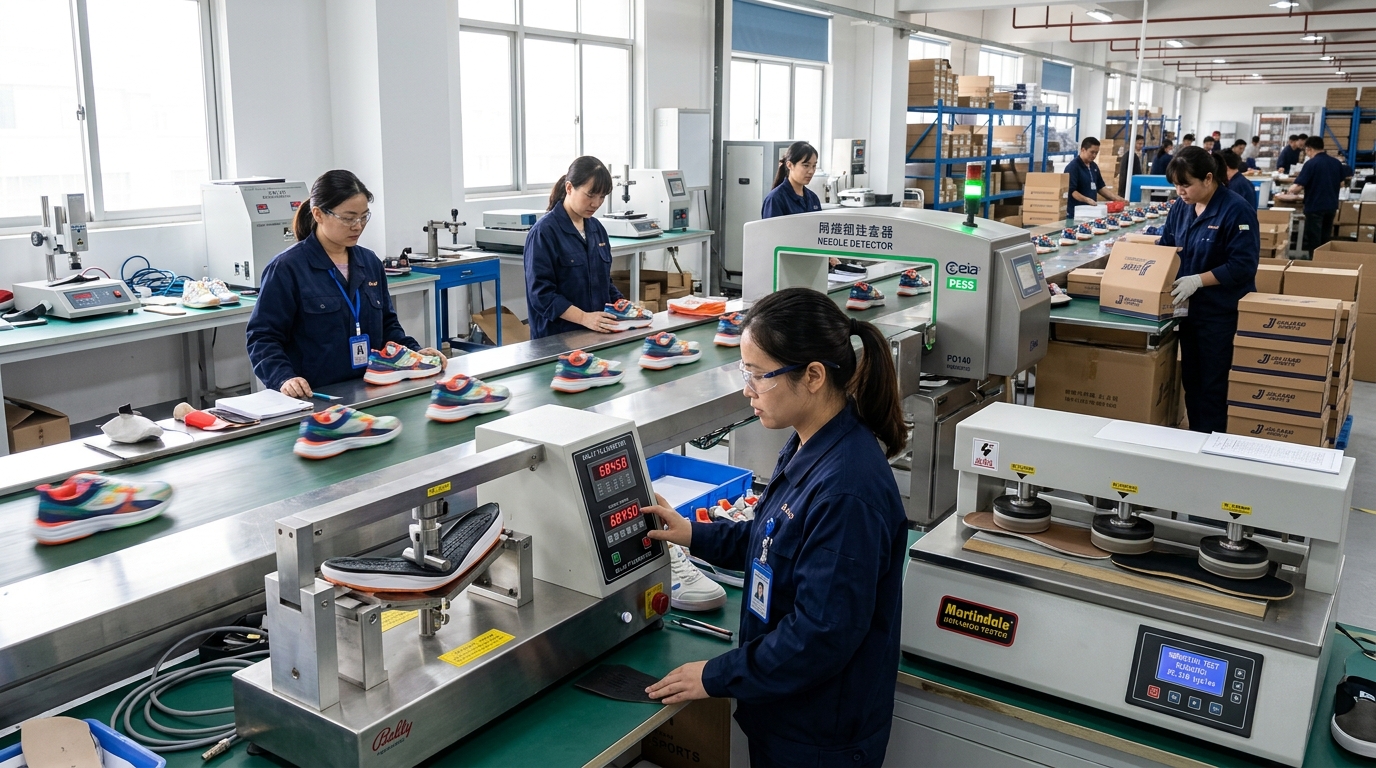
Quality assurance cannot rely on visual intuition or anecdotal floor checks; it must be grounded in unassailable empirical metrology. At WIDEWAY's in-house laboratory—built in strict alignment with SATRA (Shoe and Allied Trades Research Association) and ISO 17025 principles—every production batch undergoes a comprehensive battery of 32 physical and chemical testing checkpoints prior to packaging release.
The cornerstone of our mechanical durability testing is the Bally Flexing Endurance Test (SATRA TM55 / ISO 5423). In this demanding simulation, complete shoe assemblies and raw upper specimens are mounted in mechanized flexing jaws that repeatedly flex the forefoot through an angle of 60 degrees at a frequency of 100 cycles per minute under ambient temperatures of 20°C and sub-zero conditions of -10°C. While standard commercial grade footwear frequently exhibits upper cracking, vamp delamination, or outsole tearing after 30,000 to 50,000 cycles, WIDEWAY's athletic models are certified to withstand 100,000 continuous flex cycles without visible material rupture, adhesive failure, or microcellular degradation.
Equally vital is our sole bonding peel adhesion testing (SATRA TM411 / ISO 17708). Sample strips cut from the toe, ball, waist, and heel regions of completed footwear are gripped in an electronic universal tensile testing machine. As the crosshead separates the upper from the sole unit at a steady rate of 100 mm/min, calibrated load cells measure the peeling force in Newtons per millimeter. WIDEWAY enforces a mandatory minimum threshold of ≥ 3.5 N/mm for athletic trainers and ≥ 4.0 N/mm for outdoor trekking shoes—exceeding international standards and ensuring that catastrophic sole detachment is statistically impossible under ordinary athletic wear.
The following empirical test matrix illustrates the baseline physical standards enforced across all WIDEWAY production runs compared to conventional commodity export standards:
- Bally Flexing Endurance (Ambient 20°C): WIDEWAY Benchmark ≥ 100,000 cycles without cracking | Industry Baseline: 30,000 cycles
- Bally Flexing Endurance (Cold -10°C): WIDEWAY Benchmark ≥ 50,000 cycles without cracking | Industry Baseline: 15,000 cycles
- Sole Bonding Peel Adhesion (Upper to Midsole): WIDEWAY Benchmark ≥ 3.5 N/mm | Industry Baseline: 2.5 N/mm
- DIN Outsole Abrasion Resistance (ISO 4649): WIDEWAY Benchmark ≤ 120 mm³ volume loss | Industry Baseline: ≤ 250 mm³
- Upper Martindale Abrasion Resistance (Wet 12 kPa): WIDEWAY Benchmark ≥ 25,600 rubs without hole | Industry Baseline: 12,800 rubs
- Color Fastness to Rubbing (Crockmeter Wet/Dry): WIDEWAY Benchmark Grade 4-5 on AATCC Scale | Industry Baseline: Grade 3
- UV Yellowing Resistance (ASTM D1148 70°C, 168h): WIDEWAY Benchmark Grade 4+ (No perceptible color shift) | Industry Baseline: Grade 2-3
- Dynamic Water Immersion Flexing (SATRA TM77): WIDEWAY Benchmark ≥ 15,000 flexes without moisture ingress | Industry Baseline: 5,000 flexes
- Tensile Tear Strength of Eyelet Rows (SATRA TM181): WIDEWAY Benchmark ≥ 450 N pull force | Industry Baseline: 250 N
- Heel Cushioning Impact Attenuation (ASTM F1976): Peak G-force acceleration ≤ 12.5 G | Industry Baseline: 18.0 G
- Chemical Compliance: 100% Non-detectable Azo Dyes, Lead, Cadmium, Organotins, and Phthalates (Full EU REACH, US CPSIA & California Prop 65 conformity)
Every test run is serialized and archived in our digital QA database. If any individual batch specimen deviates by more than 2% from target engineering tolerances, our automated quality gate halts line packing, quarantines the affected production run, and triggers an immediate root-cause investigation involving the raw material compounding vendor, adhesive formulation chemist, and lasting line technician.
4. Production Case Study & Real-World Floor Problem Solving
A compelling illustration of WIDEWAY's engineering prowess occurred during a recent high-volume production initiative for a prominent European sportswear brand. The client presented a demanding design specification: a lightweight, dual-density hybrid trail running shoe that combined an ultra-soft supercritical nitrogen-infused TPU midsole core with a rigid carbon-composite torsional shank and a high-abrasion continental rubber tread. Prior contract manufacturers in Southeast Asia had failed three successive prototype trials, suffering from severe midsole shrinkage post-molding, erratic bonding delamination along the carbon plate perimeter, and unacceptable weight variance of up to 45 grams per pair.
Upon receiving the tech pack at our Chendai headquarters, WIDEWAY's senior engineering committee executed an end-to-end failure mode and effects analysis (FMEA). Our chemical laboratory identified that the nitrogen foam formulation utilized by the previous vendor contained residual thermal blowing agents that continued to degas and contract following demolding. We immediately shifted the formulation to our proprietary pure supercritical nitrogen autoclave reactor, incorporating a secondary post-cure stabilization tunnel that baked the molded midsoles at 45°C for 30 minutes, locking the microcellular void structure and eliminating post-mold shrinkage to under 0.3%.
To resolve the bonding delamination around the carbon composite shank, our tooling engineers redesigned the internal cavity of the Phylon carrier sole. Rather than relying solely on chemical adhesion, we created a mechanical interlocking lip that physically encapsulates the edges of the carbon fiber plate. Simultaneously, our chemical team introduced an ultrasonic plasma surface treatment process that micro-etches the smooth resin surface of the carbon plate prior to applying our water-based polyurethane primer. This multi-tiered intervention increased peel adhesion strength from an unstable 1.8 N/mm to an extraordinary 4.2 N/mm—well above the client's rigorous durability specification.
Finally, to eradicate pair weight variance across mass production, our cutting department implemented computerized digital weight sorting for all molded components. Every single midsole and outsole unit was automatically weighed on digital scales calibrated to 0.1g tolerance before entering the lasting line. Left and right sole components were electronically paired within a 2-gram tolerance window before conveyor introduction. As a result, the commercial production run of 120,000 pairs achieved a 99.85% first-pass yield, zero customer returns across European retail distribution, and a 12-day reduction in overall delivery lead time compared to the client's initial seasonal schedule.

5. The Procurement Director's Commercial Playbook: Cost Optimization, MOQ Agility & Container Loading
In modern footwear sourcing, superior engineering must be matched by astute commercial architecture. Sourcing directors and brand owners frequently struggle with two conflicting imperatives: the desire to minimize inventory carrying cost and risk through low minimum order quantities (MOQ), and the economic imperative to maximize container payload density and achieve competitive unit pricing.
At WIDEWAY, we bridge this commercial dilemma through our innovative Two-Track Manufacturing Framework. For established corporate enterprises and volume retail partners (such as Lidl, Aldi, and national department store chains), our high-speed automated assembly lines deliver immense volume scalability—processing containerized orders of 50,000 to 200,000 pairs with aggressive unit economics, precision barcode serialization, and standardized Euro-pallet loading. Simultaneously, for emerging direct-to-consumer (DTC) performance brands and boutique lifestyle labels, our Agile Brand Incubator provides private label manufacturing starting from an accessible 500 pairs per colorway across a standard size run.
Achieving a 500-pair MOQ without prohibitive tooling surcharges is made possible by our extensive library of over 115 active, open-mold outsole and midsole units. By utilizing pre-tested, high-performance open molds in Jinjiang, emerging brands can circumvent the standard $8,000 to $15,000 tooling investment and 30-day mold casting lead time. Our designers then customize the upper architecture, high-frequency embossed branding, tongue woven badges, custom TPU heel stabilizers, and retail shoeboxes—delivering an entirely bespoke brand aesthetic with minimal capital risk.
Logistics optimization represents another major lever for unit cost reduction. Footwear packaging volume directly dictates ocean freight costs per pair. A standard 40HQ high-cube ocean container possesses an internal volume of approximately 68 CBM. Based on WIDEWAY's standardized men's sneaker shoebox dimensions (32 × 20 × 11 cm) packed 12 pairs per master carton (carton dimensions: 62 × 42 × 33 cm, ~0.086 CBM), a 40HQ container comfortably accommodates approximately 7,800 to 8,500 pairs in premium retail packaging. For e-commerce brands prioritizing freight density, WIDEWAY offers flat-packed master carton solutions or space-saving micro-polybag packing, expanding container capacity to an astonishing 15,000 to 17,000 pairs per 40HQ container—effectively cutting international ocean freight per unit by more than 50%.
Our logistics team assists brand directors in evaluating container stuffing economics through standardized shipping benchmarks:
- 20GP Standard Container (28 CBM Volume): Accommodates ~3,200 to 3,600 pairs in retail shoeboxes (280–300 master cartons) | ~6,500 to 7,500 pairs in compressed master polybags.
- 40GP Standard Container (58 CBM Volume): Accommodates ~6,800 to 7,400 pairs in retail shoeboxes (580–620 master cartons) | ~13,000 to 14,500 pairs in compressed master polybags.
- 40HQ High-Cube Container (68 CBM Volume): Accommodates ~7,800 to 8,500 pairs in retail shoeboxes (650–700 master cartons) | ~15,500 to 17,500 pairs in compressed master polybags.
- LCL Consolidated Pallet Shipping: Custom consolidated crating with moisture-barrier stretch wrap and impact sensors for test orders from 500 to 2,500 pairs.
6. Frequently Asked Questions (FAQ) by International Footwear Buyers
To assist international procurement managers in evaluating contract manufacturing partnerships with WIDEWAY, our sales engineering team has compiled detailed technical answers to the most common procedural inquiries:
Q1: What are WIDEWAY's standard production lead times, and how quickly can pre-production samples (PPS) be dispatched?
Standard bulk production lead time is 25 to 35 calendar days following client sign-off on the final pre-production sample (PPS) and receipt of deposit. For repeat replenishment orders utilizing established upper patterns and open molds, lead time can be expedited to 20 to 25 calendar days. Physical prototype development (including digital last preparation, CNC pattern cutting, upper stitching, and trial lasting) requires only 7 to 10 working days, backed by our in-house 3D CAD modeling studio that outputs digital sole renderings within 48 hours.
Q2: How does WIDEWAY protect proprietary customer designs, patentable sole tooling, and brand intellectual property (IP)?
Intellectual property protection is governed by legally binding bilateral Non-Disclosure Agreements (NDA) executed prior to receiving tech packs, 3D files, or mood boards. Custom sole molds and dedicated lasts paid for by the client remain the 100% exclusive property of that client. Molds are engraved with unique corporate serial identifiers, tracked via RFID inventory asset tags, and securely locked in our high-security mold archive. WIDEWAY strictly enforces zero-tolerance confidentiality: custom molds are never displayed in public showrooms, exhibited at trade fairs, or utilized for third-party production.
Q3: What international social compliance and factory ethical audit certifications does WIDEWAY maintain?
WIDEWAY maintains active, independently audited certifications across all major international social compliance and ethical sourcing standards. Our factory campus holds annual audit verifications under amfori BSCI (Business Social Compliance Initiative) and Sedex SMETA 4-Pillar (encompassing Labor Standards, Health & Safety, Environmental Assessment, and Business Ethics). In addition, our manufacturing facilities operate under certified ISO 9001:2015 Quality Management and ISO 14001 Environmental Management systems, alongside GRS 4.0 (Global Recycled Standard) certification for recycled textile and polymer processing.
Q4: What incoterms, international currencies, and commercial payment structures does WIDEWAY support?
Our standard default export quotation is FOB Xiamen Port (UN/LOCODE: CNXMN) or FOB Quanzhou Port (UN/LOCODE: CNQZ), situated approximately 45 minutes and 25 minutes respectively from our factory floor. We also accommodate CIF, CFR, and door-to-door DDP (Delivered Duty Paid) logistics to client distribution centers across North America, Europe, the UK, Australia, and Latin America. For initial trial orders and brand incubator partnerships, payment terms are typically 30% T/T deposit upon purchase order confirmation and 70% balance against copy of Bill of Lading (B/L) and third-party QC inspection sign-off. For long-term corporate enterprise accounts with established volume, we accept 100% Irrevocable Letter of Credit (L/C at sight) or Sinosure-backed OA 30/60 days credit facilities.
7. Strategic Roadmap: Initiating an OEM/ODM Partnership with WIDEWAY
In conclusion, the future of successful footwear brand management lies in partnering with manufacturing organizations that combine massive industrial scale with agile engineering responsiveness, unyielding quality metrology, and absolute social compliance. Whether your company is an established international brand seeking to diversify manufacturing capacity across resilient Chinese supply clusters or an innovative direct-to-consumer label looking to launch a breakthrough technical footwear line with a low 500-pair MOQ, WIDEWAY GROUP (Jinjiang Wanwei Import & Export Co., Ltd.) possesses the infrastructure, craftsmanship, and dedication to transform your vision into commercial market leadership.
To initiate an engineering review or request a comprehensive factory direct FOB quotation, follow our streamlined 3-step onboarding protocol:
- 1. Tech Pack & Design Submission: Send your 2D design sketches, 3D CAD files, or physical reference shoe specifications—including target order quantities, upper material preferences, and target retail price bands—directly to our executive sales desk at amy@widewaygroup.com or via WhatsApp at +86 185 0595 9266.
- 2. Technical Feasibility & BOM Cost Analysis: Within 8 working hours, WIDEWAY's engineering committee will deliver a comprehensive BOM (Bill of Materials) itemization, open-mold recommendations, and a binding FOB Xiamen/Quanzhou price quotation.
- 3. Rapid Physical Prototyping: Upon commercial confirmation, our digital sample room initiates pattern grading and material acquisition, dispatching physical pre-production sample shoes to your headquarters within 7 to 10 working days for fit, wear, and laboratory validation.
We warmly welcome international procurement delegations, brand founders, and third-party audit inspectors to visit our modern manufacturing facilities in Chendai Town, Jinjiang City, Fujian Province, China (World Footwear Capital). Experience firsthand the precision, passion, and perfection that establish WIDEWAY as the premier contract manufacturing partner for global footwear giants.